Shuttlecock Guide
How to Choose the Most Durable Feather Shuttlecock Without Sacrificing Stable Flight
Learn how to compare feather shuttlecock durability, flight stability and real cost per session before choosing a club or competition shuttle.
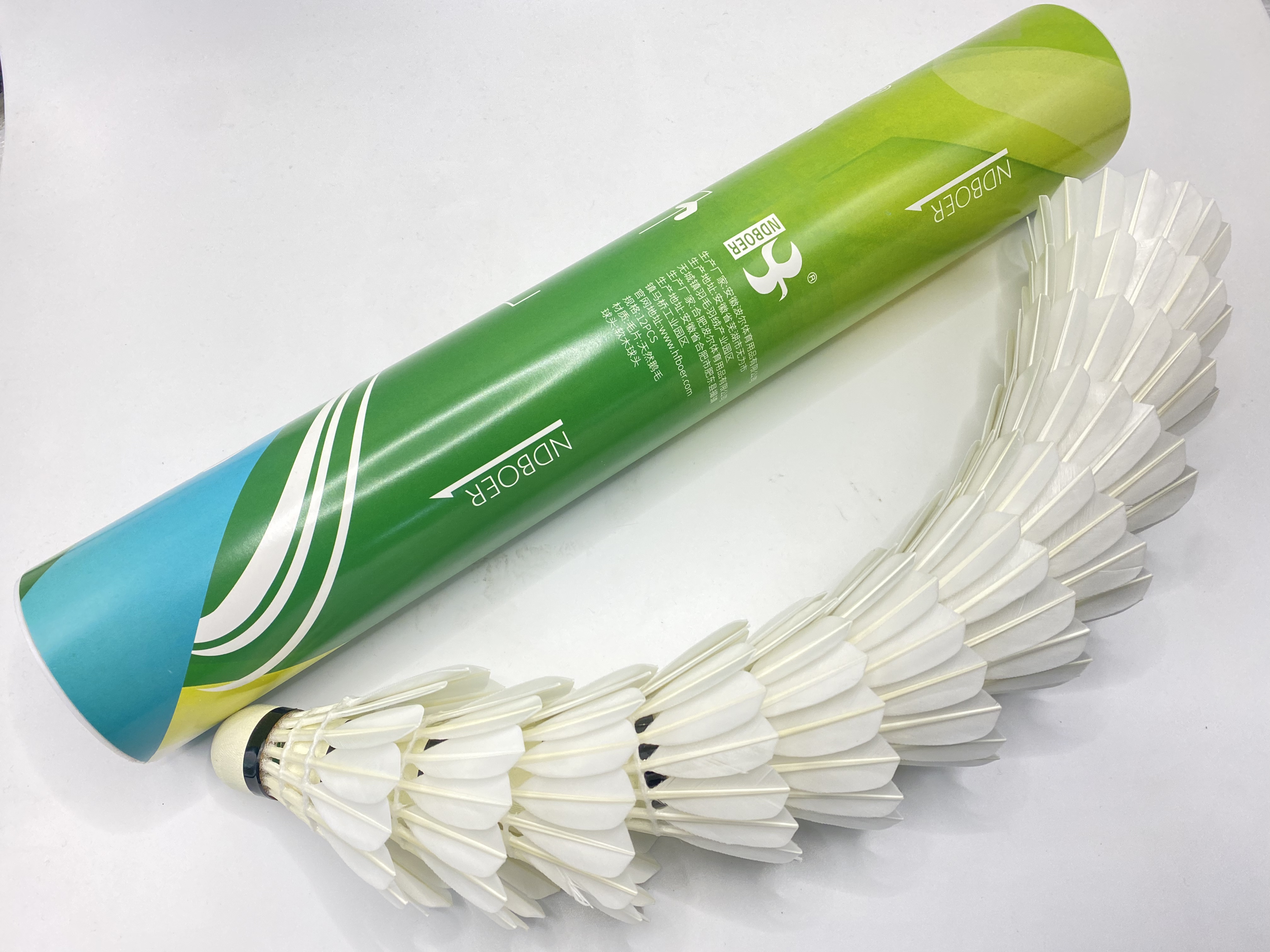
How to Choose the Most Durable Feather Shuttlecock Without Sacrificing Stable Flight
The most durable feather shuttlecock is not simply the one that survives the greatest number of hits. A useful shuttle must also keep a predictable trajectory, recover cleanly after impact and feel consistent from one tube to the next. Once the skirt loses symmetry or a feather twists out of alignment, the shuttle may remain physically intact but no longer be suitable for serious training.
For clubs, the practical target is therefore usable durability: how long a shuttle maintains acceptable flight and feel under your actual playing conditions.
What determines feather shuttlecock durability?
Four elements work together.
1. Feather selection and grading
Straight, well-matched feathers create a balanced skirt. Premium goose sword feathers are commonly selected for higher-grade shuttles because they can support strong flight feel and consistency. Selected duck feathers can be a sensible choice for cost-controlled training. Species alone, however, is not a quality guarantee. Feather thickness, curvature, cut, moisture condition and matching are all important.
2. Cork-head construction
The head influences rebound, impact feel and how force travels into the feather stems. Full natural cork, three-layer composite cork, double-layer composite cork and fiber-cork structures are designed for different balances of feel, consistency and cost. A stronger feather skirt attached to a poorly matched head will not automatically produce a better shuttle.
3. Assembly consistency
Insertion angle, skirt diameter, thread tension, adhesive application and final correction all affect flight. Small geometric differences can produce wobble even when the materials look good. This is why batch control matters as much as the headline material specification.
4. Storage and playing conditions
Natural feathers react to dry air, humidity, temperature, transport and storage. Very dry feathers can become brittle. Players who mishit frequently or strike the skirt during fast doubles will also consume shuttles more quickly than players with clean contact.
Durability and flight stability should be tested separately
A product can score well in one area and poorly in another. Use a simple two-part assessment:
| Test area | What to observe | Stop using the shuttle when | |---|---|---| | Structural durability | Split vanes, snapped shafts, loosened thread, head deformation | Damage creates a safety or consistency problem | | Usable flight life | Wobble, drift, inconsistent length, slow recovery after impact | The shuttle no longer follows a repeatable trajectory | | Feel | Contact response, rebound and feedback | Players consistently reject the feel for the intended level | | Batch consistency | Differences between pieces and tubes | Variation makes speed or flight unpredictable |
Do not convert a catalogue rating into a guaranteed number of rallies or games. Player level and hall conditions can change the result dramatically.
A practical comparison within the BOER range
The following figures are catalogue positioning, not independent laboratory guarantees:
| Model | Main construction | Catalogue durability | Suggested use | |---|---|---:|---| | BOER No.1 | Premium goose sword feather, full natural cork head | 9.5/10 | Elite training and community-level competition | | BOER No.2 | Premium goose sword feather, three-layer composite cork | 9/10 | Club competition and advanced training | | BOER No.3 | Preferred goose sword feather, double- or three-layer composite cork | 8.5/10 | Regular club training, coaching and school use | | BOER No.500 | Goose straightened feather, double-layer composite fiber cork | 8/10 | Club teaching, school and amateur training |
The highest-rated model is not automatically the most economical. A club may use No.1 for match simulation, No.2 for strong-player sessions and No.3 or No.500 for high-volume drills.
Calculate cost per usable session, not price per tube
Use this formula:
Cost per usable session = total shuttle expenditure ÷ number of completed sessions
Record the number of shuttles opened, the player level, session duration, room conditions and why each shuttle was retired. A lower-priced tube that becomes unstable early may cost more than a higher-grade tube that remains usable for longer.
How to run a fair sample test
- Test the same speed under the same indoor conditions.
- Use comparable players and drills.
- Rotate shuttles so one piece is not exposed to all hard smashes.
- Record flight, feel, visible damage and retirement reason.
- Test several pieces from each model rather than judging one shuttle.
- Repeat the test on another day if temperature or humidity changes significantly.
The current NDBOER/FeatherTrain sample rule starts from six pieces per model per speed, which is useful for a controlled first comparison.
Frequently asked questions
How many games should one feather shuttlecock last?
There is no reliable universal number. Contact quality, player strength, humidity, storage and acceptable flight standard all change the result. Measure your own cost per session instead.
Does a more expensive shuttlecock always last longer?
No. Higher pricing may reflect feather grade, cork construction, selection and consistency, but the shuttle still needs to match the intended players and environment.
Can a damaged shuttle still be used for drills?
Sometimes, if its flight remains predictable and there is no safety concern. Separate match-simulation shuttles from feeding or beginner-drill shuttles so damaged pieces do not distort technical practice.
Choose with evidence
The best durable shuttlecock is the model that maintains stable flight at an acceptable cost in your hall. Start with a mixed sample pack, record the results, and then request a model-and-speed recommendation through the sample request page.
Need help choosing the right shuttlecock?
For model selection, sample testing, club supply, wholesale or OEM enquiries, contact our shuttlecock specialist directly.
WhatsApp: +86 199 5512 6120
BR-SHUTTLECOCK
Contact Expert
BOER No. 1 Competition Grade Goose Knife Feather Badminton Shuttlecock
Loading contacts…